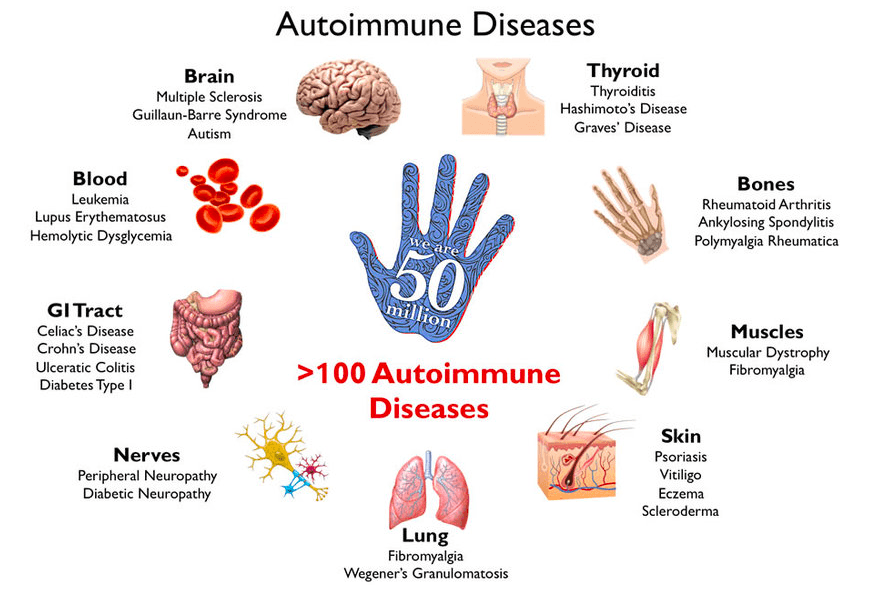
In my last article, I explained how the immune system runs efficiently and now I will describe what happens when it doesn’t. When the immune system is not working smoothly, you can develop an autoimmune disease and that’s when the body’s immune system attacks your healthy cells so the body can’t tell the difference between the invader cells and the healthy cells. It is a result of an overactive immune system. There are as many as one hudred autoimmune diseases and they’re afflicting millions of people. They claim that autoimmune disease can not be cured but that the conditions can be controlled by drugs. I disagree. I believe that it can be cured. Drugs are not the end all for everything. Their are people who believe that drugs cure all and that’s fine if it feels right for you. I feel it all stems from what enters your system. Whatever you put in, is what you get out. The foods we eat can wreak havoc on the body. Not everyone can enjoy the same foods. Although we have the same anatomy, it doesn’t mean that we function the same. Not everyone can eat the same foods and process them the same way. The functions might be the same but the reactions to the foods are different. Scientists are not certain as to what triggers these diseases but some theorize it to be certain medications, genetics and/ or infections. They claim the female gender is more prone to an autoimmune disease.
About ten years ago, I was diagnosed with the beginning of lupus and my doctor advised me that I have nothing to worry about. I thank God that with all the symptoms that occur with autoimmune disease, I exhibit about three and they’re not severe. I attribute that by building up my immune system due to healthy eating habits and taking vitamins. Below is a brief list of the autoimmune diseases.
1. Addison disease.
2. Celiac disease.
3. Graves disease.
4. Inflammation bowel disease (I.B.D).
5. Multiple sclerosis (M.S).
6. Rheumatoid arthritis (R.A).
7. Systemic lupus erythematosus (Lupus, S.L.E)
8. Type 1 diabetes.
9. Guillain- Barre syndrome.
10. Psoriasis.
11. Hashimoto’s thyroiditis.
12. Myasthenia gravis.
13. Sclerodema.
14. Vasculitis.
15. Pernicious anemia.
Doctors run blood tests to diagnose diseases that may be present in the body. It can actually take up to three months and sometimes years for the right diagnoses because the symptoms of autoimmune disease are similar. There are many different signs to look for but the most common are listed below.
– Fatigue.
– Frequent fevers.
– A general sick feeling.
– Joint pain and swelling.
– Skin problems such as redness or rashes.
– Stomach pain or digestive issues.
– Swollen glands.
In my next article, I will list the foods to eat and the one’s to avoid along with autoimmune recipe’s.